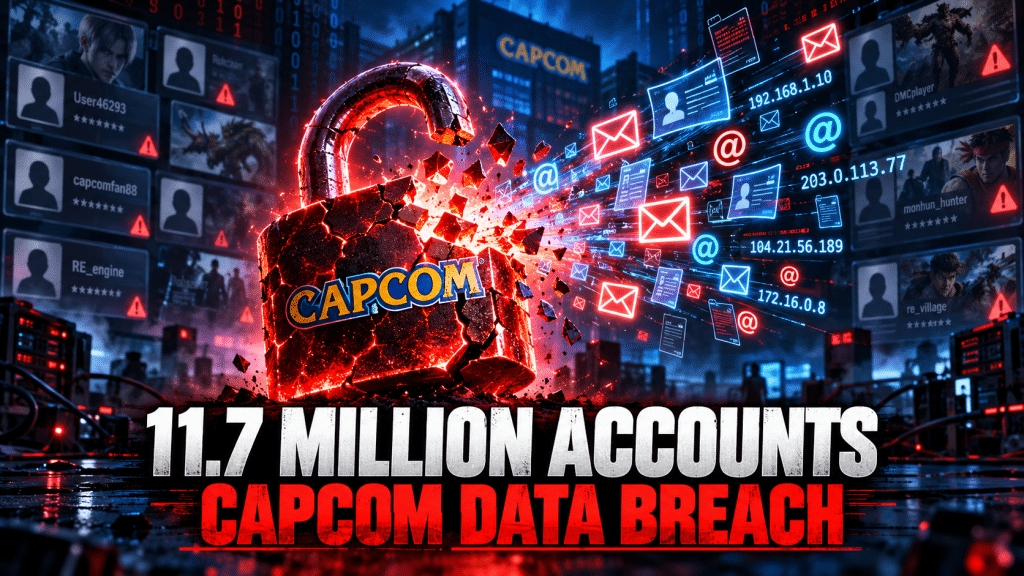
Capcom has confirmed a major data breach affecting more than 11.7 million CAPCOM ID accounts worldwide. The publisher behind Resident Evil, Monster Hunter and Street Fighter says email addresses, IP addresses and login details were exposed, though it insists passwords and payment information were not leaked. If you have a CAPCOM ID, here is what the Capcom data breach means for you and what you should do now.
What happened in the Capcom data breach
According to Capcom’s official notice, the company spotted signs of unauthorized access to its CAPCOM ID system on October 19, 2026. It blocked the activity the same day and confirmed that an intrusion had taken place.
Over the following days, Capcom set up an internal response team, confirmed that data had been leaked and that some account passwords had been changed, and reported the incident to the police and Japan’s Personal Information Protection Commission. The breach was announced publicly on October 22.
Capcom has not said how the attackers got in or who was behind the attack. It says it has identified and dealt with the method used, and that its investigation was ongoing at the time. It has since been completed.
Update, 31 October 2026: On 23 October Capcom said its investigation into the scope of the incident is complete and that it will keep monitoring CAPCOM ID and related services. Of the 196 accounts that had their passwords changed without permission, an unauthorized party accessed the e-Capcom store account pages of 19 of them, all in Japan. Capcom says no credit card information was involved and that it is notifying those customers.
What data was exposed
In total, the Capcom data breach affected 11,774,247 records tied to CAPCOM ID accounts. For all of them, the leaked information includes:
- Registered email addresses
- IP addresses from the most recent login
- Account creation date and time
- Last login date and time and total login count
For 43 accounts, more personal details were also exposed, including date of birth, gender, country or region, and nickname.
Capcom also found that 196 accounts had their passwords changed by someone else without permission. The company says it has reset the passwords on those accounts and is contacting affected users directly.
Were passwords or credit cards leaked?
According to Capcom, no. The company says the passwords customers set themselves have not been confirmed as leaked, and no credit card information was involved. CAPCOM ID services are still running, and the breach does not affect your ability to play Capcom games.
That is good news, but it doesn’t mean there is no risk. A leaked email address is still valuable to scammers, especially when it comes with real account details attached.
What CAPCOM ID users should do now
The biggest danger after the Capcom data breach is phishing. Scammers may send convincing emails pretending to be from Capcom, using your real details to make them look legitimate. To stay safe:
- Don’t click links in unexpected emails about your Capcom account. Go to the CAPCOM ID site yourself through a bookmark or search instead.
- Check your account and change your password if anything looks unusual.
- Change reused passwords. If you used your CAPCOM ID password anywhere else, update it on those services too.
- Turn on extra security, such as two-step verification, wherever it is available.
- Never share login or payment details in reply to an unsolicited message, no matter how official it looks.
The US Federal Trade Commission has a helpful guide on how to recognize and avoid phishing scams if you are unsure whether a message is genuine.
Not Capcom’s first security incident
This is not the first time Capcom has been hit. In November 2020, the company suffered a ransomware attack that exposed internal documents and some personal data. Security researchers say the new Capcom data breach does not appear to be connected to that earlier attack.
The Capcom data breach also comes during a busy period for security news in gaming. Sony recently released a new PS5 system update shortly after jailbreak reports, and PC players were caught off guard when the NVIDIA App switched on a new AI agent feature by default. Both are a reminder to keep an eye on what your gaming accounts and software can access.
For now, players affected by the Capcom data breach don’t need to panic, but they should stay alert. Check your account, be careful with emails that claim to come from Capcom, and make sure your passwords are unique.