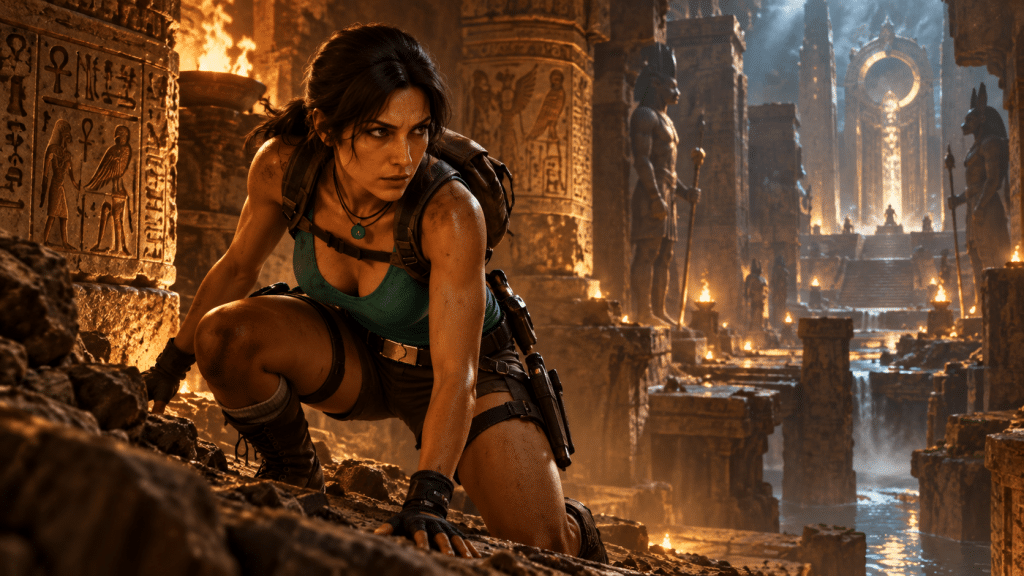
The team behind Tomb Raider: Legacy of Atlantis says the moments fans remember most from the original 1996 game will stay almost exactly as they were. At the same time, some of the classic game’s more unrealistic habits are being rethought to fit a far more lifelike take on Lara Croft’s first adventure.
The comments come from an interview in Edge magazine issue #429, where developers from Flying Wild Hog and Crystal Dynamics spoke about how they are approaching the remake.
What Tomb Raider Legacy of Atlantis is keeping
Flying Wild Hog creative director Michał Kuk explained the team’s rule of thumb with a simple exercise. He asked players to imagine they had just finished the first Tomb Raider, then close their eyes and replay it in their head.
“Your brain remembers the things that generated the most emotions for you. These are the things that have to be in the [remake] almost untouched.”
For Kuk, that means the locations, vistas, objects and big moments that stuck with players for decades. If something left a strong impression back in 1996, the plan is to recreate it faithfully rather than reinvent it.
What is changing in the remake
Not everything is being carried over one-to-one. Crystal Dynamics experience director Jeff Adams said the jump in realism makes some of the original’s game logic harder to defend.
“As we bring the level of realism up, there are some things from the original we struggle to justify.”
His example was finding a medkit inside a tomb that had been sealed for 10,000 years. In an abstract 1996 game, nobody questioned it. In a modern, realistic one, it stands out. Tomb Raider Legacy of Atlantis replaces those pickups with a crafting system, letting Lara make healing items from materials she finds in and around the tombs.
Other modern additions include:
- Crafting and skill trees carried over from the Survivor trilogy.
- Updated combat that still nods to some of Lara’s classic moves.
- Less hand-holding in exploration, with fewer clearly marked paths and handholds.
Getting lost is part of the plan
That last point may be the biggest change from recent Tomb Raider games. The Survivor trilogy marked climbable surfaces and routes so clearly that players rarely got lost. The original game was the opposite: obscure, slow and built around figuring things out on your own.
Adams said the team wants to bring back that sense of isolation. The idea is for players to “get on your own, get lost, then find your way back,” and to find unexpected rewards by wandering off the main path. It’s a bold choice, especially as data suggests most players don’t finish story games as it is.
A careful balance for a classic
Remaking a beloved game always means deciding what to protect and what to update. Recent remakes have taken very different approaches, and publishers like Konami have leaned on creator-driven remakes of their own classics. Others have stayed closer to the source, as with the Shadow of the Colossus PC port.
Tomb Raider Legacy of Atlantis sits somewhere in the middle. It keeps the emotional core of the 1996 original while modernizing the systems around it. It is also the second official remake of the first game, following Tomb Raider: Anniversary in 2007.
Release date and platforms
The remake is being developed by Crystal Dynamics and Flying Wild Hog in Unreal Engine 5 and published by Amazon Game Studios. It is set to launch on February 12, 2027 for PlayStation 5, Xbox Series X|S, Nintendo Switch 2 and PC. Alix Wilton Regan voices Lara Croft. You can find more background on the project on its Wikipedia page.