Steam wishlists aren’t worth what they used to be. A new analysis of 160 games released on Steam between 2020 and 2025 found that each wishlist now turns into roughly half as many sales as it did a few years ago, a trend developers are calling “wishlist inflation.”
The study was put together by game marketing consultant Chris Zukowski and published on his blog, How To Market A Game. It uses sales data that developers submitted directly from their Steamworks reports.
How much Steam wishlists have dropped in value
The analysis split the games into two groups: 34 titles released between 2020 and 2022, and 126 released between 2023 and 2025. It then compared how many copies each game sold for every wishlist it had at launch.
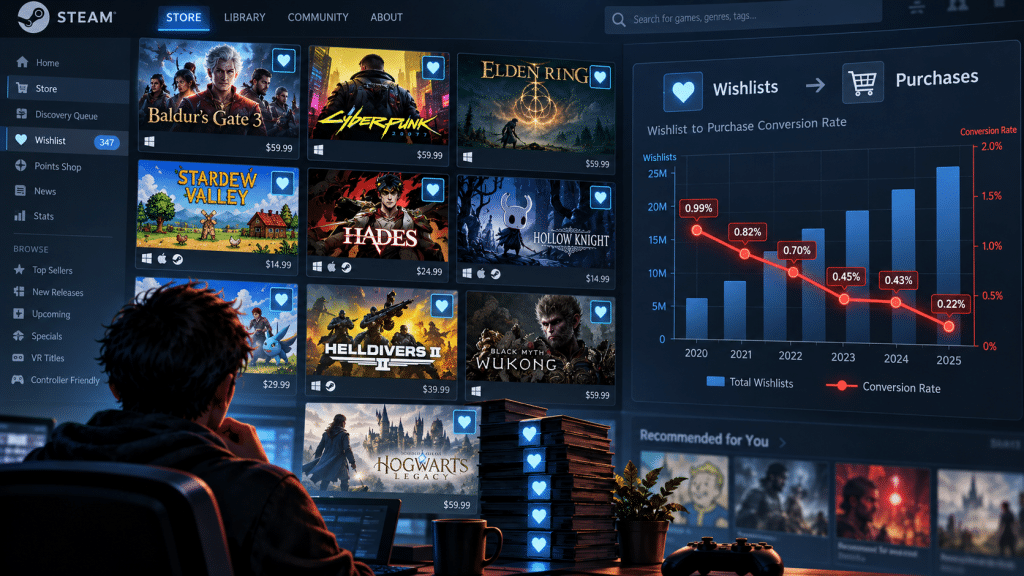
- First month: 0.45 sales per wishlist for 2020–2022 games, compared with 0.22 for 2023–2025 games.
- Six months: 0.82 compared with 0.43.
- One year: 0.99 compared with 0.70.
In other words, a game launching today with the same number of Steam wishlists as a game from 2021 can expect to sell around half as many copies in its first month. The gap narrows over time, but newer games still trail behind after a full year.
Why wishlists are converting worse
Zukowski points to three main reasons for the drop:
- Wishlisting got easier. Valve added the option to wishlist a game straight from the hover tooltip in the store, without opening its page. That turned wishlists into something closer to a bookmark than a real intent to buy.
- More festivals. Steam events such as Next Fest now feature far more games than they did in 2020. Wishlists collected during these events tend to convert less often.
- Everyone is chasing wishlists. More developers now know that wishlists matter and actively push for them, which adds to the overall supply.
There is also a lot more competition. Steam saw around 14,000 new releases in 2023 and close to 21,000 in 2025, so each new game is fighting for attention in a much more crowded store.
With so many games launching every day, players add titles to their list just to keep track of them, then never come back. That habit alone is enough to drag down how many Steam wishlists end up as sales.
Steam wishlists still predict sales
Despite the headline numbers, the analysis does not say wishlists have stopped mattering. The number of wishlists a game has at launch still predicts its first-month sales almost as well as it did before. The statistical fit dropped only slightly, from 0.77 to 0.72, which Zukowski considers within the margin of error for a sample this size.
He also looked at “wishlist velocity,” or how many wishlists a game gained in the 30 days before launch. That turned out to be a weaker predictor than the total count, and combining the two only improved the result slightly.
Other industry data paints a similar picture. Research firm GameDiscoverCo has found that first-week conversion for larger games has dipped only slightly in recent years, suggesting the bigger challenge is earning wishlists in the first place.
What it means for developers and players
For developers, the main lesson is to update their expectations. Anyone still using the rules of thumb from 2020, when first-week sales of 20 to 30 percent of wishlists were often quoted, may be overestimating how well their game will sell. Valve’s own Steamworks wishlist documentation still treats wishlists as a key signal, and this data backs that up, but each one is now worth less.
For players, it explains why so many smaller games launch quietly despite big wishlist numbers. If you want to see which new releases are actually catching on, check our Steam new releases chart for live player counts.