
Every day Valve publishes a list of the most played games on Steam. Saved copies of that page go back to 2008 and cover almost every day since 2011, so we lined up nearly 18 years of Valve’s own charts with each game’s launch date on Steam. The question was simple: how old are the games people actually play?
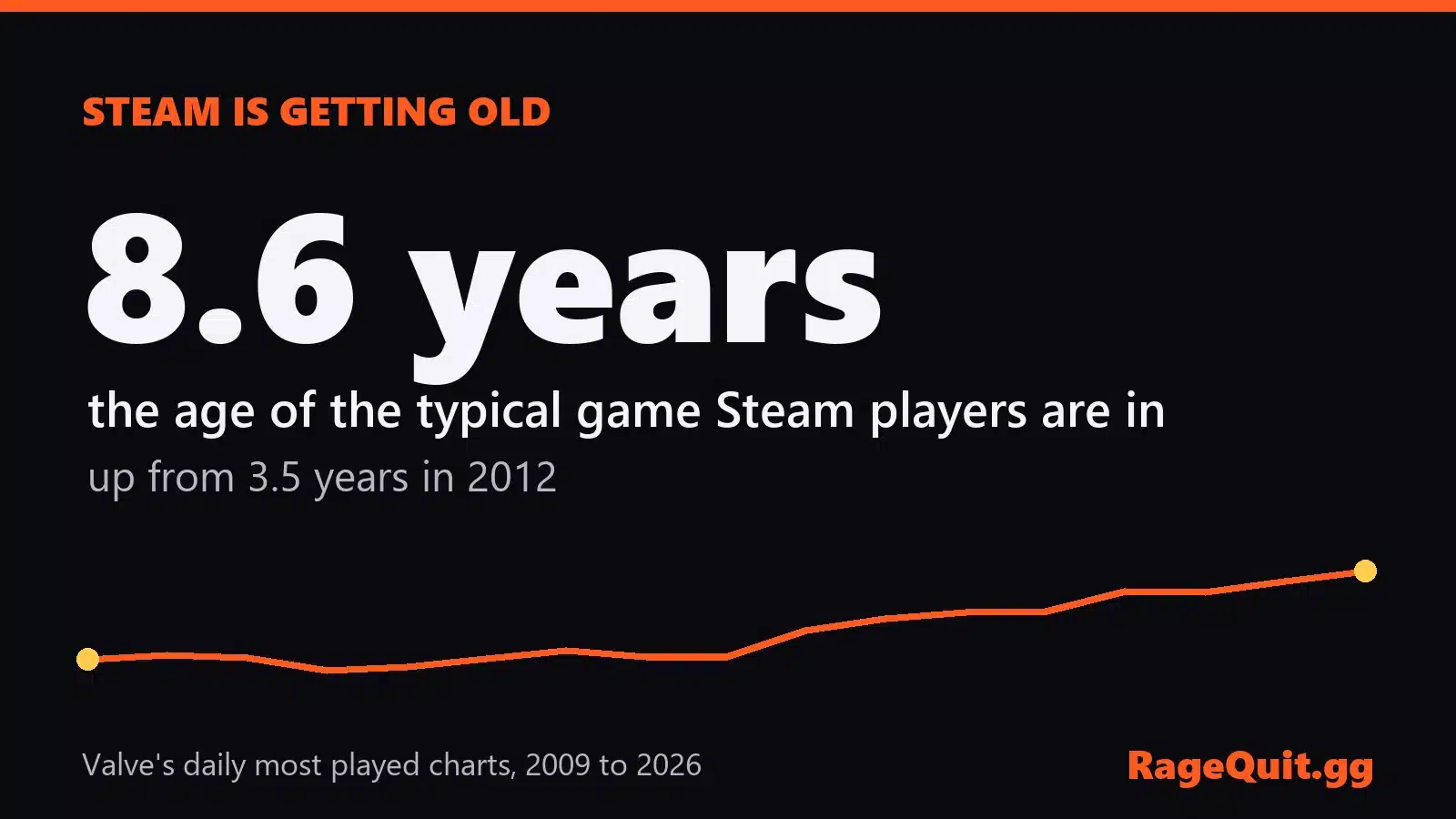
The answer has changed a lot. In 2012 the typical Steam player was in a game about 3.5 years old. In 2026 it is 8.6 years. Games that are ten or more years old went from 1.3% of the daily Top 75 to 31.6%.
The typical Steam player is in a game 8.6 years old
We took the 75 most played games on every day in the charts and measured how long each one had been out on Steam. Weighted by players, the age of the game the typical player is in rose from 3.5 years in 2012 to 8.6 years in 2026. The plain average age of a Top 75 game, where every game counts once, rose from 2.3 to 6.8 years.
For years the number barely moved: the player-weighted age stayed between about 3 and 4.5 years until 2018. Since then it has climbed almost every year.
How old are the games people play on Steam?
Years since launch, Steam’s daily Top 75 most played games, yearly average
Old games hold 31.6% of the top spots
The mix of the Top 75 shows the same shift. In 2012, games under a year old filled 36.3% of the slots and games older than ten years filled 1.3%. In 2026, new games fill 18.4% and ten-year-old games fill 31.6%, about 24 times their 2012 share.
Who fills Steam’s Top 75, by game age
Share of Top 75 slots by years since launch, average over every day of the year
Top 75 slots held by games 10+ years old
Share of Steam's daily Top 75, average over every day of the year
Steam’s Top 10, then and now
A single day makes it concrete. On 15 October 2012, the ten most played games on Steam were on average 3 years old. On 18 August 2026, the Top 10 averaged 6.5 years.
Steam’s Top 10, then and now
Most played games on Steam on 15 October 2012 and on 18 August 2026, with each game’s age that day
2012
- Dota 21.1 yrs
- Team Fortress 25 yrs
- XCOM: Enemy Unknown0 yrs
- Borderlands 20.1 yrs
- Counter-Strike12 yrs
- Counter-Strike: Source8 yrs
- The Elder Scrolls V: Skyrim0.9 yrs
- Sid Meier's Civilization V2.1 yrs
- Counter-Strike: Global Offensive0.9 yrs
- Dishonored0 yrs
2026
- Counter-Strike 214.7 yrs
- Dota 214.9 yrs
- PUBG: BATTLEGROUNDS9.4 yrs
- Apex Legends5.8 yrs
- Palworld2.6 yrs
- Bongo Cat1.5 yrs
- Rust12.7 yrs
- Marvel Rivals1.7 yrs
- TBH: Task Bar Hero0.2 yrs
- Delta Force1.7 yrs
Steam’s 20 immortals
Some games simply never leave. These 20 games are at least ten years old and were in the daily Top 75 on 90% or more of the days in 2026. The oldest, Garry's Mod, has been on Steam since 2006.
Steam’s immortals
Games at least 10 years old that were in the daily Top 75 on 90% or more of days in 2026



















Less room for new games
The share of the Top 75 that goes to games released in the last twelve months peaked at 37.9% in 2013 and fell as low as 11.9% in 2023. Breakout years still happen, but the baseline has moved: a new release now has to push aside a game that players have stuck with for a decade.
Top 75 slots held by games under a year old
Share of Steam's daily Top 75, average over every day of the year
Fewer games break into the charts at all. Between 2011 and 2013 an average of 103 games reached the daily Top 75 for the first time each year. In the last three full years it was 72.
Games reaching the daily Top 75 for the first time
Count per year (first appearance in Valve's charts since 2008)
Is it just Counter-Strike and Dota 2?
No. Counter-Strike 2 and Dota 2 have huge player counts and both count from their original Steam launch, so they pull the player-weighted age up. Without them, the typical player’s game still aged from 4 years in 2012 to 6.2 years in 2026, and the share of players in games five or more years old went from 30.2% to 57.1%. The per-slot figures above count every game once, so they are not driven by any single title.
Why is this happening?
The charts show what changed, not why. Several things line up with it: more games are built to be played for years with regular updates and seasons, many of the biggest are free to play, multiplayer games keep their friend groups together, and modding keeps older games fresh. These are explanations worth testing, not conclusions from this data.
How we did it
- Charts: Valve’s daily list of the most played games on Steam (store.steampowered.com/stats until September 2022, then the official Steam charts), one saved copy per day where one exists, 5,449 chart days from 2009 to 2026.
- Top 75: the older page listed fewer games on some days, so every day uses the 75 most played games to keep the years comparable.
- Launch date: each game’s release date from its Steam store page. For Early Access games that were already in the charts before their 1.0 date, we use the first day they appear in the charts. Software such as Wallpaper Engine and SteamVR is left out; 2,232 games are included.
- Age: days between the chart day and the launch date. Yearly figures average every chart day of that year. “Weighted by players” counts each game by its daily peak players; “average game” counts every game once.
- 2026: a partial year (charts up to the most recent saved day).
- Cleaning: a small number of archived chart days show impossible one-day spikes. A day more than five times the game’s own surrounding days is set to its local median. Three idle item-drop apps (Banana, Egg, Cats) are left out because their player counts mostly come from item farming.
- Counter-Strike 2 replaced Counter-Strike: Global Offensive on the same Steam page in 2023, so it counts from Counter-Strike: Global Offensive’s first day in the charts. Dota 2 likewise counts from its first day in the charts.
- Figures describe Steam’s most played games, not every game on Steam or other platforms. The data shows patterns, not their causes.
Download the data: Steam Top 75 age by year (CSV) and Steam’s immortals 2026 (CSV). Free to use with a link to this page.
Use this study
Journalists, creators and researchers are welcome to use these figures and charts. Please link to this page as the source.
Cite this study
RageQuit.gg (2026). Steam Is Getting Old: The Typical Player’s Game Is Nearly 9 Years Old. https://ragequit.gg/news/steam-is-getting-old-study/